
Article Series: The Future of Theatre in Boston
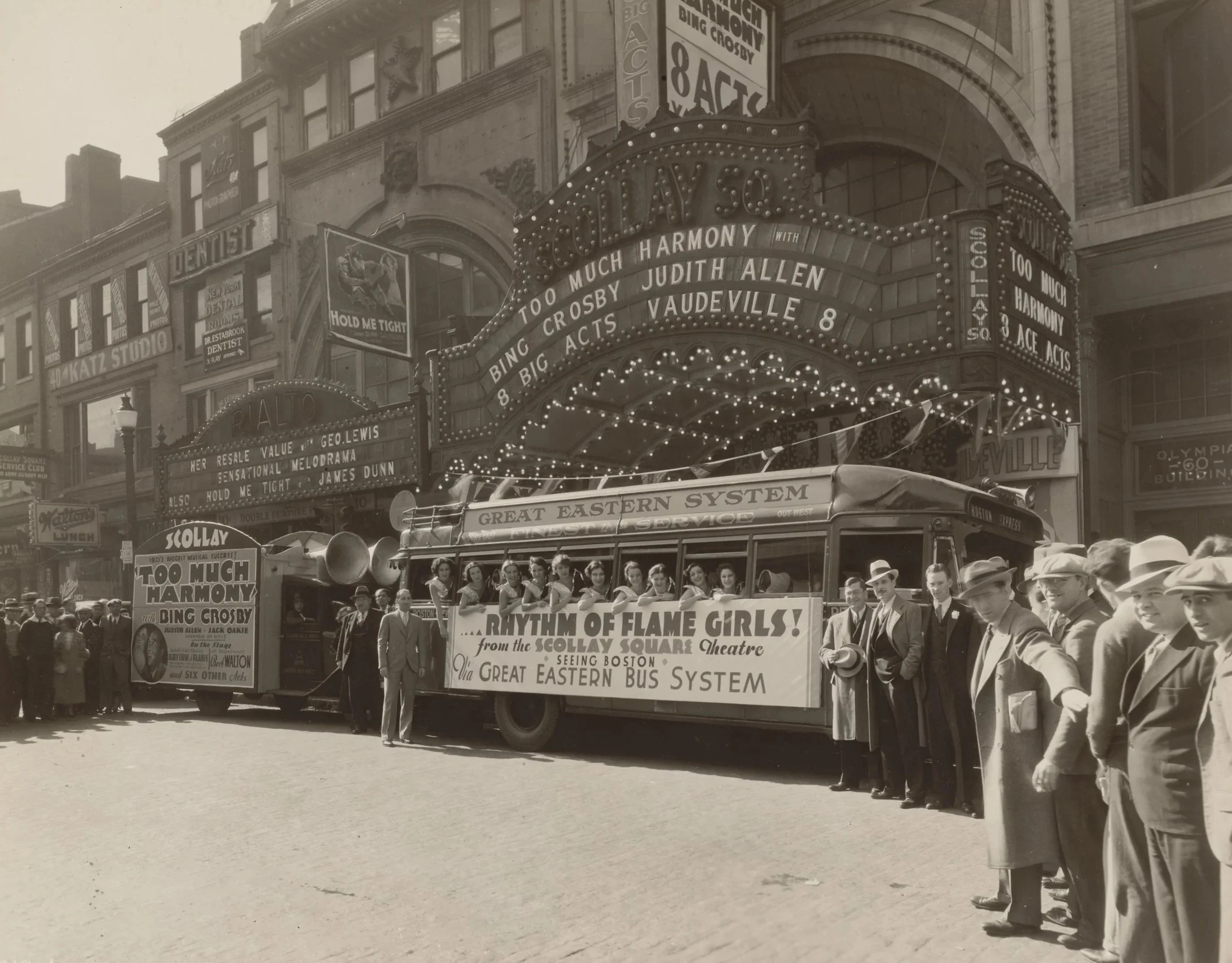
Scolllay Square Theatre, 1933, Boston Public Library Digital Archives
The Creative Economy Has a Structural Problem Nobody’s Talking About
A Jobs and Economic Reality Check
Article 1 of 7
There’s a conversation happening in creative industries across the country — in boardrooms, green rooms, and city planning offices — that doesn’t always get named directly:
Why do so many cities with world-class artistic talent still struggle to build sustainable creative economies?
It’s not a new problem. And it’s not unique to any one city.
But it is solvable — and I think the path forward starts with being honest about what’s missing.
Over the next several articles, I’m going to be exploring that question through the lens of a city I know deeply — not just as a theatre producer, but as a native Bostonian. Boston is a useful case study precisely because it has so much going for it: elite training institutions, a strong tourism economy, a passionate audience base, and a history of commercial entertainment that most people have forgotten.
And yet — like so many cities outside New York and LA — it hasn’t been able to fully convert that potential into a sustainable, thriving commercial theatre ecosystem.
This isn’t about promoting a single project. And it isn’t a critique of what already exists — Boston’s nonprofit theatres, its touring productions, its presenting organizations do vital, irreplaceable work.
It’s about asking a harder question:
What happens when the ecosystem is out of balance — and what does it take to complete it?
Boston Has the Talent—So Why Are We Losing It?
Why does a city with this much talent, history, and cultural infrastructure still struggle to support sustainable careers in the arts?
And more importantly:
What would it look like if we got it right?
I’ve spent my career working across entertainment—from Boston stages to global productions with Disney—and one thing has become very clear:
Boston is not lacking in talent.
We are graduating some of the most skilled performers, designers, technicians, and creative thinkers in the country every single year.
And yet… most of them leave.
Not because they want to.
Because they don’t see a path to staying.
To get hired in Boston theatre, you had to leave Boston first.
That was the reality when I graduated from The Boston Conservatory — and for many artists, the only path to a sustainable career still leads out of the city, even today. So I left. And so did most of my peers.
A City That Once Led the Industry
It’s easy to forget now, but Boston was once one of the most important theatre cities in America.
In the late 19th and early 20th centuries, Boston was home to dozens of active theatres—at one point rivaling New York in number of venues and frequency of performances.
This was not a secondary market.
This was a center of innovation in commercial entertainment.
One of the more influential figures in that era was Benjamin Franklin Keith, a Boston-based impresario who helped define what would become modern vaudeville. Through his network of theatres, Keith established a new standard for variety entertainment—structured programming, consistent quality, and a business model that made live performance scalable and profitable.
What he built in Boston didn’t just succeed locally—it spread nationally.
In many ways, the foundation of American commercial entertainment was shaped based on Keith’s successes in Boston.
Where We Lost Our Way
But innovation didn’t stop.
Technology changed.
The rise of motion pictures fundamentally altered the entertainment landscape. And this is where Boston—like many cities—struggled to adapt.
Live theatre and vaudeville began to decline as film became more accessible, more scalable, and more profitable. Many theatres that once housed live performance transitioned into movie houses.
Over time, particularly in areas like Scollay Square, that transition took a sharper turn. What had once been a vibrant entertainment district became increasingly associated with adult cinemas and fringe content, reflecting broader shifts in both the industry and urban economics.
By the mid-20th century, this transformation became part of the justification for large-scale urban renewal efforts.
The city made a decision:
To tear it down.
Scollay Square was razed in the 1960s, replaced by Government Center—an attempt to reset and modernize downtown Boston. But in doing so, Boston didn’t just remove buildings.
It dismantled an entire ecosystem of commercial entertainment.
And in the vacuum that followed, another district emerged: The Combat Zone.
The Long-Term Impact
What Boston gained in modernization, it lost in continuity.
For decades, the city’s relationship with commercial entertainment became fragmented—caught between strong nonprofit arts institutions, touring productions, and a lack of locally rooted, scalable commercial ventures.
Meanwhile, other cities adapted.
New York evolved from vaudeville to Broadway and beyond.
Chicago built a thriving ecosystem of resident productions.
Boston became a place where shows come in, perform, and leave—without leaving behind long-term employment or infrastructure.
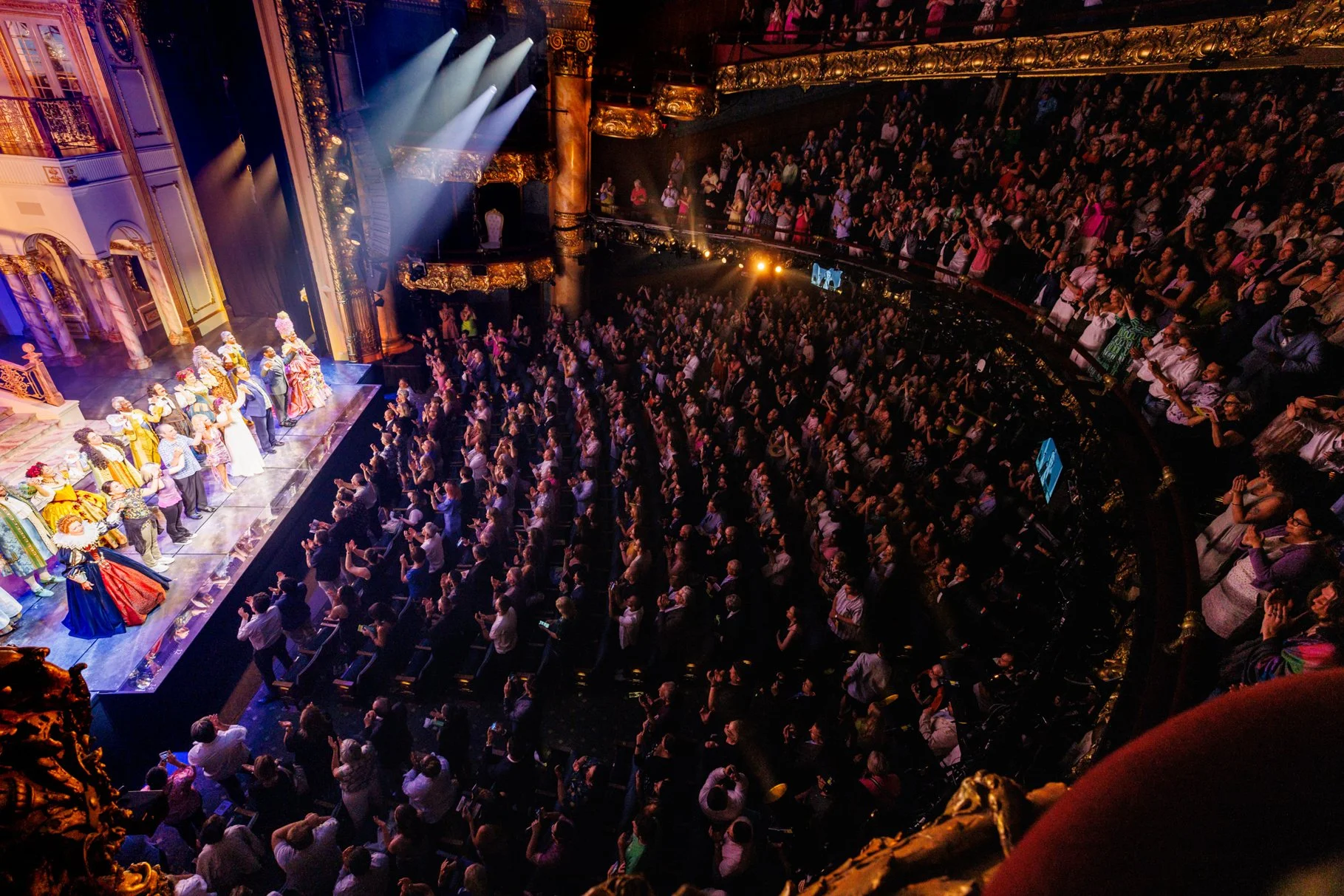
“The Queen of Versailles” 2024 Pre-Broadway Tryout at the Emerson Colonial Theatre, Boston
Photo: Ken Yotsukura

A Ghost Light Illuminates an Empty Stage at the Citizen’s Bank Opera House, Boston
Photo Courtesy: Evgenia Eliseeva
The Economic Reality We’re Not Talking About Enough
Today, we’re facing a different—but deeply connected—challenge.
Massachusetts—especially Greater Boston—is one of the most expensive regions in the country.
Housing costs continue to climb
Small businesses face rising overhead
Creative ventures are increasingly difficult to sustain without scale
At the same time, much of our arts infrastructure is built on models that were never designed to provide long-term economic stability.
Nonprofit theatres are essential. They are the backbone of Boston’s cultural identity.
But structurally, they rely on:
Grants and philanthropy
Limited-run productions
Lean staffing models
Which often results in:
Part-time or seasonal employment
Limited access to healthcare and benefits
Few clear pathways for career advancement
So what happens?
People leave.
Or they piece together a living across multiple roles.
To be clear: this is not a failure of the organizations that exist. Nonprofit theatres, presenting institutions, and touring productions are doing exactly what they were designed to do — and doing it well. The gap isn’t in their performance. It’s in the overall architecture of the ecosystem.
Think of it like a tripod. Every photographer, filmmaker, and cinematographer knows that a tripod only works because all three legs are present and load-bearing. Remove one and nothing stays upright — no matter how strong the other two are.
Nonprofit theatre is one leg — mission-driven, community-rooted, artistically essential. Touring productions are another — bringing scale, visibility, and national-caliber work to local audiences. But the third leg — locally rooted, commercial, long-running production — is largely absent in Boston.
And here’s what makes a tripod remarkable: each leg can be adjusted independently, calibrated to the specific terrain it’s standing on. No two cities will build this third leg in exactly the same way. The terrain is different — the history, the venues, the workforce, the audience. But the principle holds everywhere: without that third leg fully extended and load-bearing, the instrument on top — the creative ecosystem, the workforce, the cultural economy — cannot be stabilized. It cannot capture what it’s capable of capturing.
Without it, the people who hold the whole thing together — the artists, technicians, designers, and administrators — are the ones absorbing the imbalance.
This Is Not Just an Arts Issue—It’s an Economic Development Issue
Boston’s commercial entertainment economy is not a monolith—and not all sectors are struggling.
Sports, for example, is a thriving and highly successful industry in this city, demonstrating that Boston can support large-scale, revenue-generating entertainment enterprises.
The challenge is that this success has not translated evenly across all sectors—particularly in live, locally rooted commercial theatre.
The creative economy as a whole:
Drives tourism
Supports restaurants, hotels, and nightlife
Activates neighborhoods
Creates jobs across multiple sectors
And yet, one of its most scalable components—commercial theatre—remains underdeveloped in Boston.
A Personal Perspective—and a Reason to Be Optimistic
As someone building a new kind of entertainment venture here in Boston, I’ve seen both the challenges and the opportunity firsthand.
I’m proud that this work has been recognized by the City of Boston through the S.P.A.C.E. Grant, awarded by Mayor Michelle Wu and the Office of Economic Opportunity and Development.
That support signals something important:
Boston is ready to invest in its creative future.
But public support alone isn’t enough.
We also need to rebuild the commercial infrastructure that once made this city a leader in entertainment.
The Opportunity in Front of Us
Boston has everything it needs:
A highly trained creative workforce
A strong tourism economy
A growing demand for immersive, experience-driven entertainment
A deep and largely untapped cultural history
What we’re missing is the third leg of the tripod. The bridge between art and commerce that allows:
Long-running productions
Stable employment
Scalable business growth
And talent to stay rooted here
And here’s what I believe: when that third leg is extended and locked into place, everyone benefits. Nonprofit theatres gain commercial partners and collaborators. Touring productions arrive in a city with a stronger year-round entertainment culture. Artists have more reasons — and more ways — to stay. The instrument finds its balance. And the ecosystem captures something it hasn’t been able to hold steady before.
The terrain in Boston is specific — its history, its architecture, its audience, its workforce. The way we extend that third leg here will look different from how Chicago did it, or how New York built it over a century. It should. That’s not a limitation. That’s the point. A tripod adjusts to the ground it stands on. What matters is that all three legs are present, load-bearing, and working together.
So What Comes Next?
That’s what this series is about — not just for Boston, but as a model for what any city with this level of talent and ambition can build when it’s intentional about it.
Over the next few weeks, I’ll be exploring:
What a commercial theatre ecosystem could look like — and what it has looked like, here and elsewhere
Why immersive, experience-driven entertainment is reshaping the industry nationally
How Boston’s history — especially in magic and illusion — connects to where the industry is heading
And what it means to build something that creates jobs, opportunity, and long-term impact for an entire creative community
Boston has led before. There’s no reason it can’t again.
But this time — and I’d say this to any city watching — it requires being intentional about what we build, why we build it, and who it’s built for. It requires knowing your terrain. And it requires committing to all three legs.
Whether you’re an artist, a producer, a business owner, a policymaker, or someone who believes in the future of live entertainment — in Boston or anywhere else — I hope you’ll follow along.
— Jonathan