
The Case for Locally Produced Commercial Entertainment in Boston
Boston has world-class talent, a serious audience, and one of the richest theatrical and entertainment histories in the country. And yet the people who make live entertainment in Boston struggle to build a life here. There is a specific reason, and it can be precisely identified.
A Balanced Creative Economy Rests On A Tripod
Picture the creative economy of a great city as something that has to be held up and kept in balance — like a camera resting on a tripod. A tripod holds the camera steady to take a clear, focused picture only when its three legs are extended fully and balance the camera’s weight evenly. Take one leg away, and whatever sits on top tips over and crashes to the ground. Boston’s theatrical economy rests on exactly such a tripod, and its three legs are three different kinds of organizations.
• Presenting organizations and touring shows. These bring in work produced elsewhere and present it to local audiences — the touring Broadway productions and the venues that host them, such as Broadway In Boston, the Boch Center, the Emerson Colonial Theatre, and the Wilbur. This leg is commercial, but it is not local. The production is created and owned in another city, and when it leaves, most of the revenue and the ongoing jobs leave with it.
• Regional and local non-profit theatre companies. These produce work locally, rooted in the community and sustained by grants and donations — companies such as the American Repertory Theater, the Huntington Theatre, Lyric Stage, and SpeakEasy Stage. This leg is local, but it is not commercial. The money comes in through philanthropy and grants rather than profit, and by design these organizations are structured never to earn a surplus to reinvest in wages or growth.
• Local producers creating commercial entertainment. These are locally owned, for-profit enterprises that create and run their own permanent productions. This leg is both local and commercial — and it is the only one of the three in which the majority of the money generated stays in the local economy: paid to local workers, spent with local vendors, taxed by the city, and reinvested in the next production. It is the leg that turns a talented workforce into lasting local careers. And in Boston today, it is almost entirely missing.
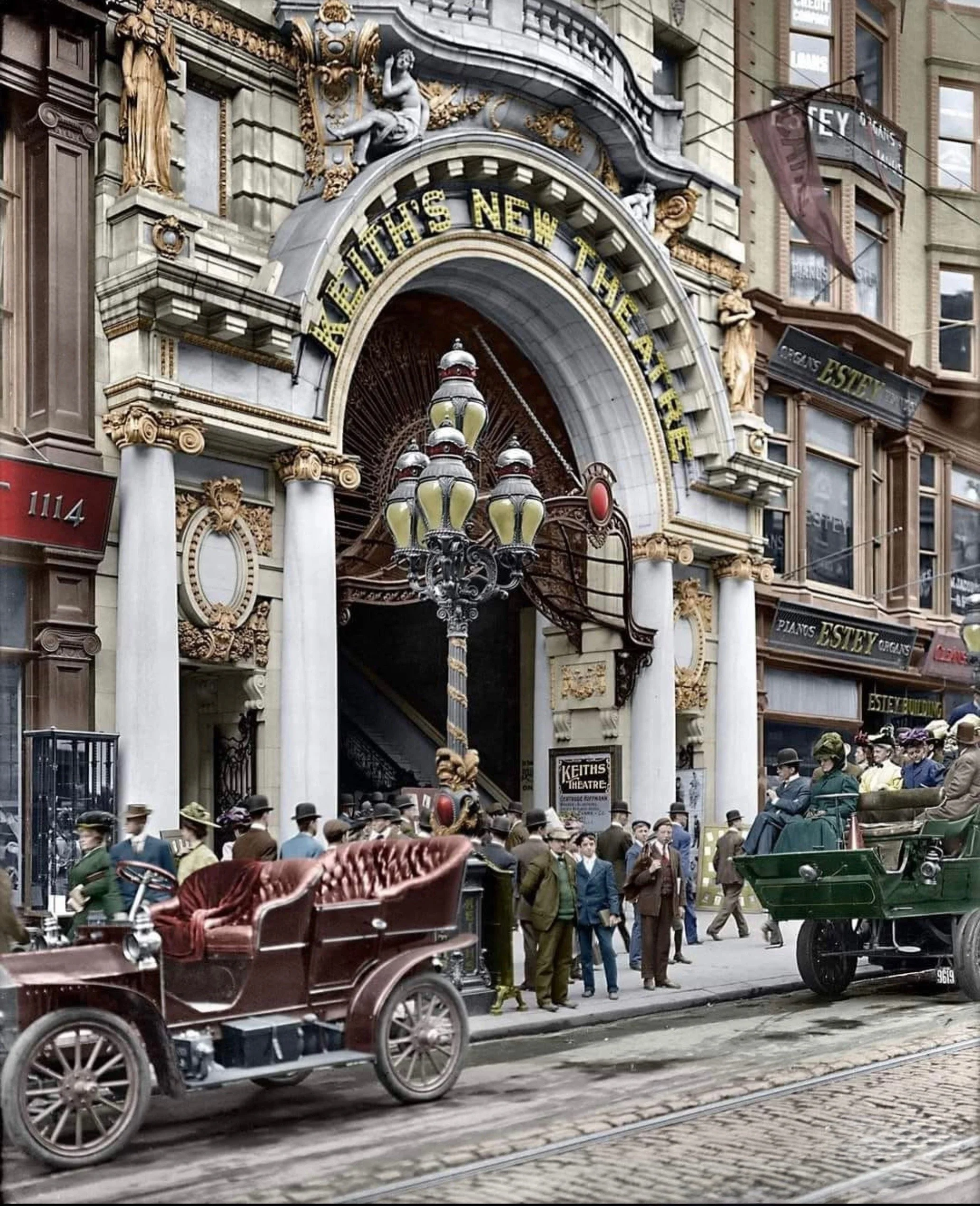
Keith’s New Theatre, Washington Street entrance, run by B.F. Keith, operated from 1894-1928 in Downtown Boston
Boston is not missing something it never had. It is missing something it once led the world in, allowed to disappear, and never rebuilt — even as its audiences kept proving, for decades, that the appetite was still there.
A Headcount Is Not The Same As A Livelihood
When Boston celebrates its creative economy today, it reaches for a number: 70,000 workers, the figure the city and its cultural leaders cite as proof the sector is thriving. It is a big, reassuring number, and it hides the problem rather than revealing it. A count of workers says nothing about whether those workers can actually make a living — and for most of the people who make live entertainment in this city, the honest answer is that they cannot, at least not here, not for long.
The reason traces directly back to the missing leg of the tripod metaphor. Consider what the two remaining legs offer a working artist or technician.
The touring leg offers pay, but no permanence. When a touring production comes to town, it hires local workers — stagehands, carpenters, electricians, wardrobe — to load it in, run it, and load it out. Then the trucks leave for the next city, and the work leaves with them. A permanent production employs a crew for hundreds of performances a year; a touring engagement employs them for a week or two. It is the difference between a career and a series of disconnected paychecks that rarely add up to enough hours to qualify for benefits, let alone to build a life on.
The non-profit leg — local, but structurally unable to pay. When the non-profit theatre model took hold in the late 1960s, it was widely seen as a saving grace — a way to sustain the art and create more stable jobs for the people who make it, funded by philanthropy and public grants rather than the risk of the commercial market. But decades on, the structural reality has proven harder. Because a non-profit is built, by design, never to turn a profit — every season subsidized, every budget set to break even at best — it generates no surplus from which to fund rising wages. A worker there can be employed all year and still find there is no way to earn a raise that keeps pace with the cost of living. The money isn’t withheld out of ill will; it was never designed to exist. The field’s own leaders now openly acknowledge that the model has increasingly funded institutional overhead — buildings, offices, administration — while the artists themselves are hired show by show, and that the system built to sustain them is faltering.
Put the two together and the trap comes into focus. One leg can offer wages but not continuity; the other can offer continuity but not the profit that funds rising wages and benefits. Neither can provide what a genuine career requires: steady, ongoing work and pay that grows over time. Only locally produced commercial entertainment can provide both — continuous employment and the profit from which competitive wages and real benefits are actually paid. It is the one model that can turn a talented workforce into a workforce that can afford to stay.
This is why Boston keeps losing the people it trains. A city can produce world-class talent and still export it, year after year, if it offers that talent no way to earn a living without leaving. The 70,000 figure isn’t wrong. It simply counts people, not livelihoods — and a livelihood is the thing this city’s entertainment economy is structurally unable to provide enough of.
A self-perpetuating absence is a gap so old it stops registering as a gap. The thing that is missing keeps confirming its own absence — and grows a little more permanent every time the story is told without it.

* The figure of more than 12,000 students is an approximation assembled from the published enrollment figures of Boston-area institutions with significant performing arts, music, and film programs. It is drawn from multiple institutional sources rather than a single audited count, and “performing arts and film” is defined broadly to include music.
Boston Has Almost Everything A Great Entertainment City Needs
Boston trains some of the finest performers, musicians, designers, and technicians in the country, at institutions that draw talent from around the world — more than 12,000 students studying the performing arts and film alone.*
It also has a large, educated, culturally engaged audience with the appetite and the means to fill seats. On the two ingredients most cities compete hardest for — talent and audience — Boston already has both in abundance.
And still, the people who make live entertainment in Boston struggle to build a life here. Talent leaves. Successful shows come and go without putting down roots. Something in the structure of Boston’s entertainment economy is incomplete. That missing piece has a name — and naming it is where this begins.
Boston Invented This Business - And Let It Slip Away
Locally produced commercial entertainment is not foreign to Boston; it’s native to it. Before film, when Scollay Square was the beating heart of the city’s nightlife and theatres thrived across downtown, Boston was full of local producers creating commercial entertainment — it was simply how the business worked. The most famous of them, Benjamin Franklin Keith, built the model that became modern American vaudeville from his Boston base in the 1880s. From those first Boston theatres, Keith’s circuit grew into one of the largest and most powerful theatrical operations in the country, eventually spanning hundreds of stages across the United States and Canada. His central innovation was as much about the audience as the business: Keith made commercial variety respectable and affordable enough for the whole family, opening it to a broad middle-class public — women and children included — that the rowdier entertainments of the era had excluded. In a real sense, Boston is where the business of American entertainment was invented.
And this was not an abstract industry of producers alone; it filled the city with thriving, locally run venues. The most storied was the Old Howard in Scollay Square — a locally owned commercial theatre that operated for the better part of a century, running continuously and employing a large, year-round company of performers, musicians, and stage crew. Its stage helped launch a remarkable roster of American talent, from Fanny Brice and Sophie Tucker to Abbott and Costello and Buster Keaton, making it one of the true must-see destinations of its day. Nearby, in the building that today houses the Boston Center for the Arts, a for-profit immersive attraction called the Gettysburg Cyclorama drew some two hundred thousand visitors in the 1880s — an early ancestor of the immersive entertainment being built in the city again now.
Then the ground shifted. Film arrived and rewrote the economics of entertainment, Scollay Square declined and was eventually demolished, and the generation of local commercial producers that had defined Boston’s stages faded away. Local commercial production collapsed, and crucially, was never rebuilt.
But here’s what didn’t disappear: the appetite. Even without a local producing class, commercial productions came to Boston and proved they could run for decades. Shear Madness played the Charles Playhouse for roughly forty years — the longest-running play in American history. Blue Man Group ran there for about thirty. Revues like Forbidden Broadway and Forever Plaid sustained runs of several years in the Terrace Room at the Park Plaza Hotel, a cabaret space that no longer even exists. Boston audiences showed up, year after year, decade after decade. The demand for long-running local commercial entertainment never left; what left was the local capacity to create and own it.
The Economy Described In A Way That Leaves Itself Incomplete
Here is where the problem becomes self-reinforcing. When Boston describes its own theatre economy in reports, in press coverage, and in the way the city talks about its cultural future, it tends to describe only the touring commercial productions and non-profit institutions. Locally produced commercial entertainment is left out. Not attacked, not argued against — simply absent from the picture, because it barely exists anymore to be counted.
This is a self-perpetuating absence. Locally produced commercial entertainment has been gone so long that the picture no longer seems to have a hole in it. Every description of the creative economy that leaves it out quietly teaches everyone — the public, the press, the business community, and government alike — that it was never part of the picture to begin with. The gap, described often enough and confidently enough, becomes the accepted map. And an accepted map is not questioned.
This is why the problem does not fix itself, and why no single actor is to blame. A city cannot build, invest in, or even discuss a category of enterprise that its own shared understanding of itself has quietly erased.
Boston's theatre economy has no seat in the nightlife conversation
The same self-perpetuating absence shows up a second time, in how Boston approaches its nightlife economy. The city has recognized, correctly, that a vibrant downtown after dark is an economic priority, and it has created a formal advisory body — the Nightlife Initiative for a Thriving Economy — to help guide it.
That body is genuinely wide-ranging. Its members are drawn from across the city’s nightlife — including, to the city’s credit, leaders from major non-profit cultural institutions. It reflects a real understanding that nightlife is about more than last call.
But look at the committee against the theatrical economy this city is built on, and something striking emerges: not one of its three theatrical organizations — the presenting houses, the non-profit companies, or the local commercial producers — has a seat at the table. There is no one from the presenting houses that bring touring productions downtown — not the Boch Center, the Emerson Colonial Theatre, Broadway In Boston, or the Wilbur. There is no one from the non-profit theatre companies that anchor the city’s stages — not the American Repertory Theater, the Huntington, Lyric Stage, or SpeakEasy Stage. And there is no one, of course, from the locally produced commercial entertainment that barely exists here at all.
The committee includes restaurants, bars, and clubs; DJs and music promoters; a museum and the ballet; real estate, transit, and civic voices — a genuinely broad coalition. But the entire theatrical economy — the presenting houses and the local commercial producers included, the two sides of it that are commercial — is absent from the room where the city’s nightlife policy is shaped. The absence in the creative economy is mirrored, precisely, in the conversation about nightlife.
Boston Once Built The Business of Entertainment. It Can Build It Again
None of this is beyond reach. Boston is not being asked to invent something that has never existed, or to chase a culture that isn’t its own. Cities across the country — from the resident productions of Las Vegas to the commercial theatre tradition of Chicago — treat locally produced commercial entertainment as ordinary, thriving infrastructure. It’s not exotic; it’s normal nearly everywhere but here. And Boston, of all places, already did it first.
The capacity is in the city’s own history. The appetite is proven by decades of long-running hits. What is missing is not talent, not audience, not precedent — it is the will to name the gap and rebuild across it, together.
Naming it is the first step, because a self-perpetuating absence survives precisely by going unspoken. Said out loud — clearly, factually, and often — it stops being invisible. And what becomes visible can be built.
Something has been missing from Boston’s theatrical economy for decades. Most people can’t name it.


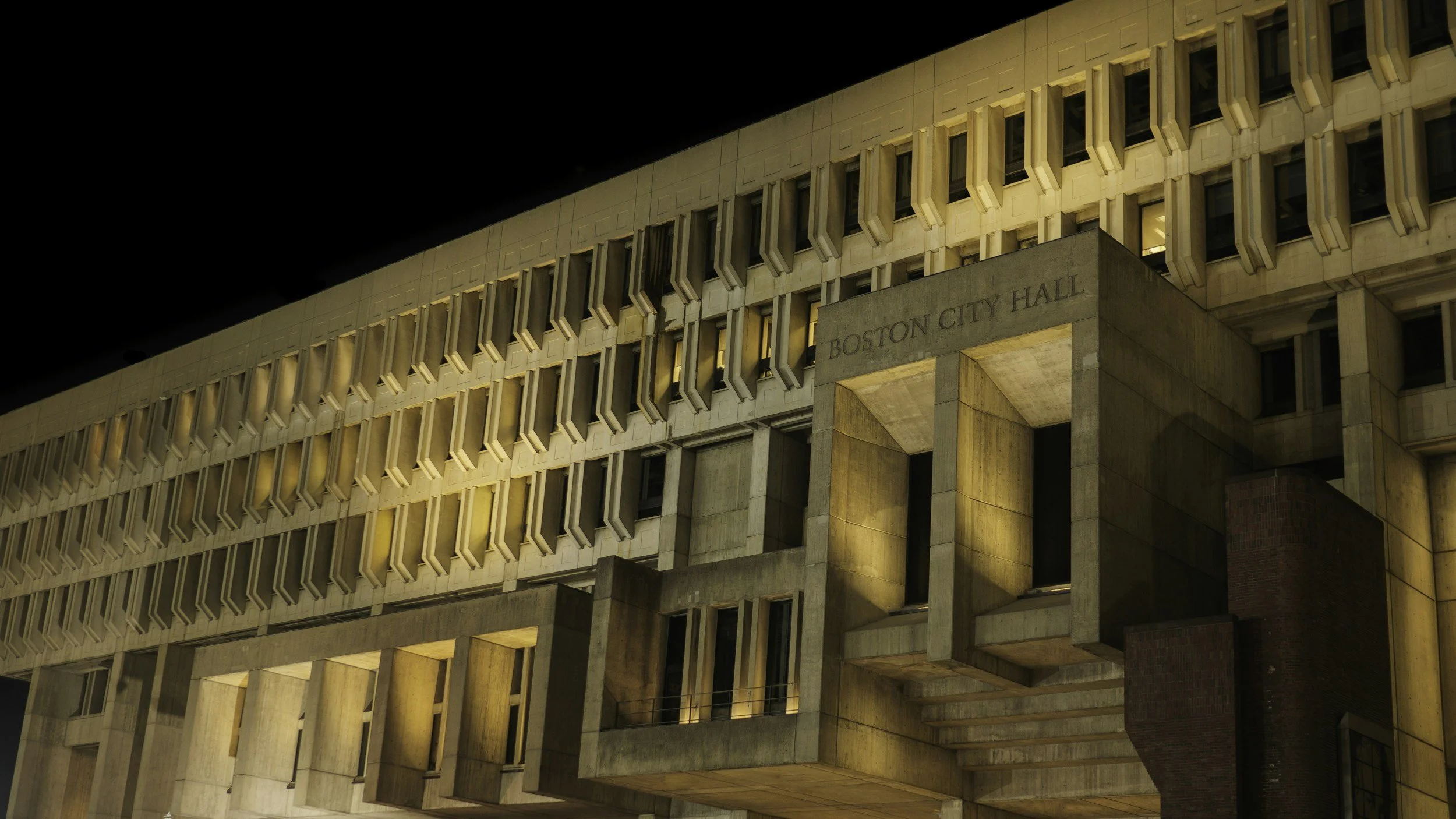
You can shape a city's nightlife without a single voice from its theatre economy. Boston is proving it.
This Is Not Only An Arts Problem, And Not Only A Government One
It would be easy to read all of this as a concern only for people who work in theatre, or as something only city government could fix. Neither is true. Locally produced commercial entertainment connects directly to challenges the whole city shares — and rebuilding it depends on government, the business community, and the public alike.
Downtown vacancy. Boston, like many cities, is working to fill empty commercial space downtown. Permanent entertainment venues draw people into the heart of the city at night and activate exactly the districts that are otherwise hard to revive — and they do it in the kind of underused commercial buildings the city is trying to fill.
Municipal revenue. A commercial entertainment venue is a for-profit business. It pays commercial property taxes and generates revenue that tax-exempt non-profit institutions, by their status, do not. In a city that funds most of its budget through property taxes, a permanent, paying downtown tenant is part of the answer.
Keeping talent. Boston trains thousands of artists each year, and loses them twice over: first the graduates who leave because the careers aren’t here, and then the working artists — some trained here, many drawn to the city from elsewhere — who tried to build a career in Boston, struggled, and finally gave up for a place where they could build a life. Each one takes their talent, their spending, and their future contribution with them.
None of this requires government to fund the arts — that is a separate debate for another day. What it requires is that the people who shape the city’s economy — in government, in banking and business, and among the private citizens who invest and advocate — recognize locally produced commercial entertainment as the ordinary, valuable industry it is everywhere else, and stop treating its absence as normal.