
Article Series: The Future of Theatre in Boston
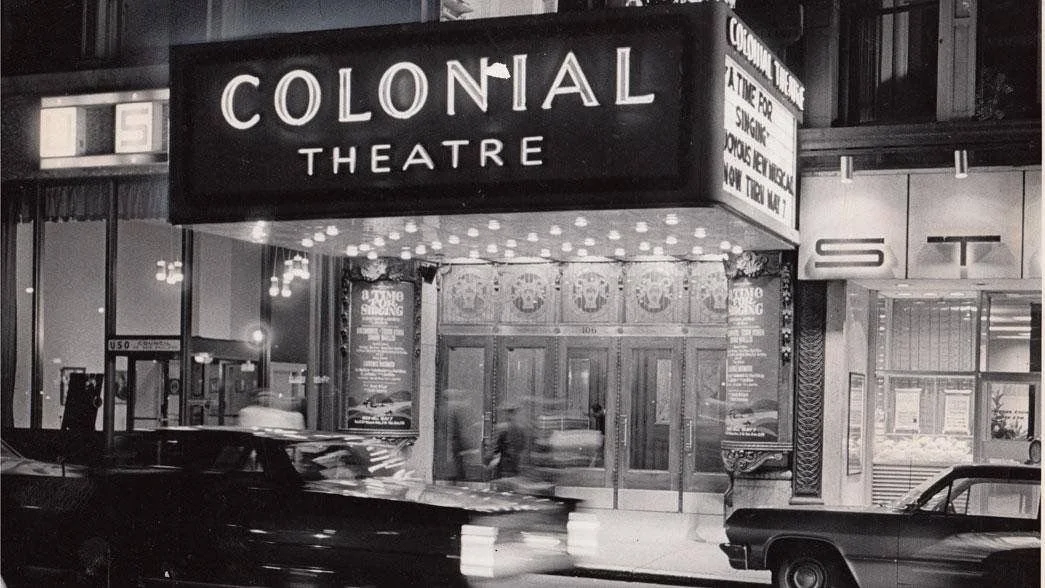
Main Entrance, Colonial Theatre, Boston, 1966
Commercial Success Without Commercial Infrastructure: The Gap Every Creative City Needs to Close
Using Boston’s Theatre History as a Case Study - and a Roadmap
Article 2 of 7
Article 1 made the case that cities like Boston aren’t facing a talent problem — they’re facing a structural one. The creative workforce exists. The audience exists. What’s missing is the third leg of the tripod: a locally rooted, commercially sustainable theatre ecosystem that allows success to compound rather than reset.
But before we talk about what’s missing, it’s worth being clear about something:
Boston — and cities like it — are not unfamiliar with commercial success in theatre.
In fact, the proof of concept already exists. Multiple times over.
We’ve Done This Before
For decades, Shear Madness ran at the Charles Playhouse.
Forty years — earning a place in the Guinness Book of World Records as the longest-running non-musical play in American theatre history.
That’s not merely a successful show—that’s an institution.
In the same venue, Blue Man Group ran for 30 years, building a global brand before closing its Boston residency in July 2025.
Together, they logged over seven decades of continuous commercial theatrical performance in a single Boston venue. And when they closed, nothing replaced them at that scale.
Which is precisely the point.
Those aren’t anomalies, they’re evidence of a model that works here.
They’re proof of concept.
Boston audiences will support long-running, repeatable, commercially viable entertainment.
But Boston’s role in commercial theatre goes even deeper than long runs.
For much of the 20th century, the city was one of the most important out-of-town tryout markets in the country—a place where Broadway-bound productions were refined before opening in New York.
Some of the most iconic works in American theatrical history didn’t just pass through Boston on their way to Broadway.
They were shaped here.
Boston’s downtown theatre district — the Colonial, the Shubert, and the Wilbur — collectively served as the workshop for the American musical and dramatic canon. Each venue played a distinct role in a shared ecosystem that made Boston, for much of the 20th century, the most important pre-Broadway tryout city in America.
Worth pausing on, as this year marks a milestone: both the Colonial and Symphony Hall are celebrating their 125th anniversaries, having opened within two months of each other in 1900. Originally intended to open simultaneously, Symphony Hall debuted in October and the Colonial followed in December. That they arrived together, almost as twins, speaks to the cultural ambition this city has always had. The Colonial immediately established itself as a home for the American musical.
Cole Porter brought Anything Goes to the Colonial. George Gershwin brought Porgy and Bess. Rodgers & Hammerstein brought Oklahoma! — then still called Away We Go! — and Carousel to the Colonial; they later brought The Sound of Music to the Shubert, where Oscar Hammerstein wrote “Edelweiss” during the Boston tryout — the last song he would ever write. Irving Berlin brought Annie Get Your Gun. Leonard Bernstein brought On the Town to the Colonial in 1944 — which means that the song “New York, New York, it’s a helluva town” was first sung not in New York, but in Boston. He returned to the Colonial in 1956 with Candide. Lerner & Loewe brought Brigadoon to the Colonial and Camelot to the Shubert — starring Richard Burton, Julie Andrews, and Robert Goulet — rewriting both during their Boston engagements before they became part of the permanent canon. Stephen Sondheim brought Follies, A Little Night Music, and Company — the last of which had an entire song replaced during its Boston run, becoming the musical that changed the face of American theatre. Jerry Herman brought La Cage aux Folles. Neil Simon used Boston stages throughout his career to test and refine his work.
And that was only at two of the three major venues.
And the Wilbur Theatre gave Broadway two of the most significant dramatic works of the American canon. Tennessee Williams’ A Streetcar Named Desire had its world premiere at the Wilbur in 1947, directed by Elia Kazan and starring an unknown Marlon Brando — a production that launched one of the greatest acting careers in American history. Eugene O’Neill’s A Long Day’s Journey Into Night tried out at the Wilbur in 1956, featuring Fredric March and a young Jason Robards Jr., propelling Robards to national stardom. Ira Levin’s Deathtrap tried out at the Wilbur in 1978, going on to become the longest-running comedy-thriller in Broadway history.
A word of honest context: New Haven’s Shubert Theatre holds the undisputed record for pre-Broadway tryouts — more than 600 engagements, double the total of any comparable venue in Boston, Philadelphia, Washington, or New York. But there’s a reason for that gap worth understanding. Boston had multiple major tryout theatres operating simultaneously — the Colonial, the Shubert, and the Wilbur — splitting bookings across a richer collective ecosystem. New Haven had one dominant house capturing everything. Boston’s argument was never about volume.
It was about significance. And Richard Rodgers captured it best when he once swore he would never open so much as a can of sardines without going to Boston first.
These weren’t small experiments or routine tryouts.
They were the works that defined what American theatre became — its musicals and its plays. And Boston was the room where they were made right.
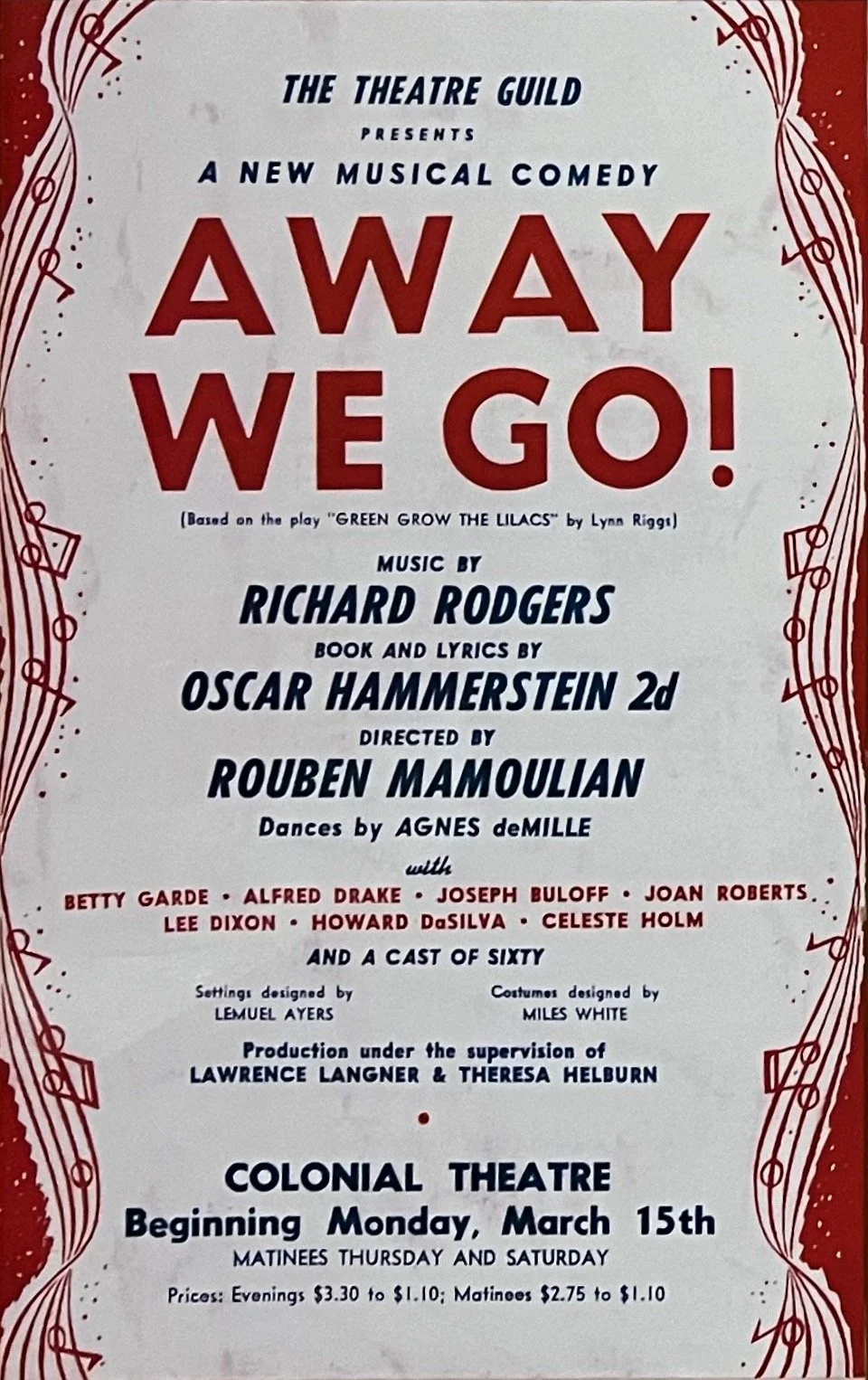
“Away We Go!”, which changed its name to become “Oklahoma!”
Colonial Theatre, Boston, 1943
And It’s Not Limited to One Type of Show
The proof of concept wasn’t confined to a single format or audience either.
The Donkey Show ran for a decade, blending nightlife and theatre into something entirely different.
Sleep No More—developed with A.R.T. and Punchdrunk—had early life here before becoming a defining immersive production in New York.
Forbidden Broadway ran for seven years at the Terrace Room at the Park Plaza in the ‘80s and ’90s, followed by Forever Plaid sustaining its own multi-year run in the same intimate venue.
Different formats.
Different audiences.
Different scales.
Same underlying truth:
The demand exists.
And There Have Been Strong Contributors, Too
It's also important to recognize the role Boston has continued to play in the commercial theatre pipeline.
Organizations like ATG Entertainment, which operates the Emerson Colonial Theatre, have brought new plays and musicals through Boston for development and pre-Broadway runs. This past summer, the Colonial hosted the pre-Broadway engagement of Paranormal Activity — directed by Felix Barrett, founder of Punchdrunk, the company behind Sleep No More — before it moved to New York. The show opened on Broadway in August 2026 to strong reviews, a reminder that work tested on a Boston stage can go on to succeed on the country's biggest.
At the same time, Broadway in Boston, part of Broadway Across America, has consistently brought top-tier national touring productions to local audiences, maintaining a strong connection between Boston and the broader commercial theatre landscape. Its 2026/27 season — opening this fall across the Citizens Bank Opera House and the Emerson Colonial Theatre — brings a full slate of touring hits to the city, from Wicked and Operation Mincemeat to The Phantom of the Opera.
These efforts matter.
They keep Boston in the conversation.
They demonstrate that there is still a viable audience for large-scale theatrical work.
But they also highlight the core issue:
Most of these productions are passing through, not staying.
So What’s Missing?
If Boston has:
Proven successes
A deep historical role in shaping American theatre
A strong audience base
A highly trained workforce
Then why haven’t we built a consistent pipeline of commercial productions?
The answer isn’t demand.
It’s infrastructure.
What a Commercial Theatre Ecosystem Actually Looks Like
In cities where commercial theatre thrives, you don’t just have successful shows.
You have a system.
That system includes:
Producers actively developing new work
Venues designed for long-running productions
Investors who understand the model
A workforce that can move from project to project without leaving the city
A feedback loop where success leads to more opportunity
It’s not one show at a time.
It’s an environment where shows can exist continuously.
The Reality of Building Theatre as a Small Business
Part of the challenge is that commercial theatre doesn’t fit neatly into how we traditionally think about small businesses.
If you look at theatre as a business—and it is one—it carries a fundamentally different cost structure than most industries.
To even open your doors, you’re facing:
• Significant upfront labor costs
• Scenic and production build expenses
• Creative development and rehearsal periods
• Specialized physical space requirements
Compared to industries like retail or food service, the barrier to entry is simply higher.
At the same time, theatre is competing directly with other forms of commercial entertainment—film, streaming, sports, and live events—which means the experience itself has to meet a high standard from day one.
That requires investment.
And Yet—There’s a Unique Advantage
What makes this even more interesting is that once a show is up and running, the business model actually shifts in your favor.
Unlike restaurants or retail—which often rely heavily on day-to-day transactions—commercial theatre has the ability to generate advance ticket sales.
You can sell inventory weeks—or even months—in advance.
That creates:
Predictable revenue streams
Cash flow visibility
The ability to plan and scale more effectively
It also gives you a level of control that many other small businesses don’t have.
With advance sales, you can identify weaker revenue periods ahead of time and adjust accordingly—through targeted discounts, promotions, or pricing strategies to move inventory.
That flexibility allows you to stabilize revenue in a meaningful way, ensuring you’re consistently covering your weekly operating expenses—which, once a production is up and running, become a relatively fixed number.
It’s a model that, once established, can be incredibly resilient.
But getting to that point is the challenge.
A System That Wasn’t Built for This Industry
Another major hurdle is structural.
The traditional small business financing system was not built with theatrical ventures in mind.
If you’re opening a restaurant or retail shop, there are established pathways:
Small business loans
Bank financing
Predictable underwriting models
For theatre, those pathways largely don’t exist.
It is extremely difficult—if not impossible—to secure traditional small business loans for a new entertainment venture.
So what happens?
You’re left to:
Raise private capital
Find investors willing to take on higher perceived risk
Build financial models that many traditional lenders don’t fully understand
In some cases, projects also shift toward nonprofit structures — and that’s often a smart and necessary choice. Nonprofit models provide access to grant funding, philanthropic support, and community infrastructure that simply aren’t available to commercial ventures.
Nonprofit organizations play a critical and essential role in Boston’s cultural ecosystem — and in every city’s. They support artistic development, take risks on new work, and bring important stories to life that the commercial market alone would never sustain.
But they were designed for a different purpose than commercial enterprise.
Their structures — boards, governance models, seasonal programming cycles, and reliance on contributed income — are built to prioritize mission. That’s exactly what they should do.
Which means that while they are essential to the ecosystem, they were never designed to be the only engine of it. Building long-running, revenue-generating productions that support large-scale job creation requires a different model — not a better one, just a different one.
That’s the gap. Not a failure of nonprofits. A gap in the overall system.
Boston’s Challenge Isn’t Capability—It’s Continuity
In Boston, we’ve had success stories.
But they’ve often existed in isolation.
One long-running show here
One immersive hit there
A development that moves elsewhere
What we haven’t built is the connective tissue between them.
So when a show closes—even after decades—it doesn’t get replaced with something new at the same scale.
The ecosystem resets instead of grows.
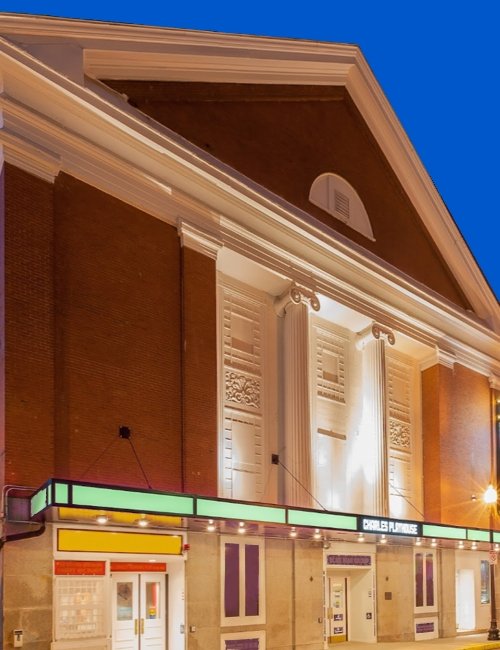
The Marquee is Bare at the Charles Playhouse, Boston, with the departure of
Shear Madness and Blue Man Group
A Broader Entertainment Perspective
Boston’s commercial entertainment economy isn’t struggling across the board.
Sports, for example, is one of the most successful and stable industries in the city.
It generates revenue.
It creates jobs.
It builds long-term audience loyalty.
So the question becomes:
Why hasn’t that same level of infrastructure and consistency developed in commercial theatre?
The answer isn’t audience appetite. It isn’t market size. It’s the same thing we identified in Article 1: the third leg of the tripod hasn’t been built.
The Opportunity Right in Front of Us
We’re not starting from zero.
We already have:
A track record of successful long runs
A deep history of shaping American theatre
Institutions actively contributing to the pipeline
A growing demand for immersive, experience-driven entertainment
A city investing in its creative economy
What’s needed now isn’t another success story.
It’s a repeatable system.
Not just to create another successful show—but to build a model that allows success to repeat, scale, and sustain itself.
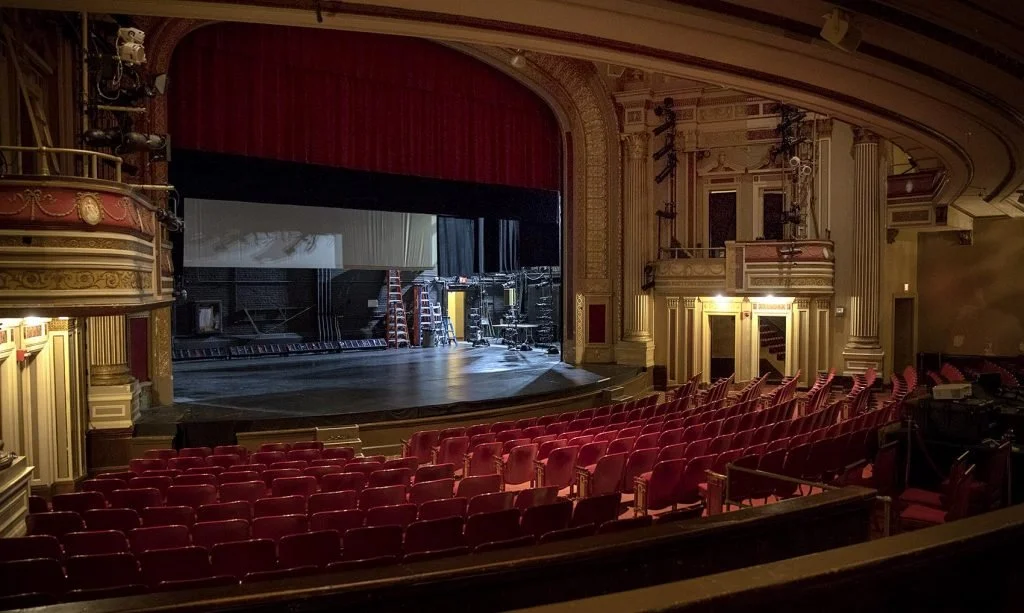
An Empty Strand Theatre in Boston. Does it spark despair of potential?
Photo: WBUR
What Comes Next
If Article 1 was about understanding the problem, this is about recognizing the opportunity.
Because the next step isn’t theoretical.
It’s practical.
It’s about:
What kinds of experiences audiences are actually seeking
Why immersive theatre is changing the business model
And how Boston is uniquely positioned to lead in that space
That’s where we’re headed next.
And it’s a conversation that matters well beyond Boston — because the model we’re describing is one any city with this level of talent and ambition can begin building.
Boston has already proven the demand. What we haven’t built yet is the system to sustain it.
Now the question is whether we’re ready to build the system that allows it to thrive again—and consistently.
— Jonathan