
Article Series: The Future of Theatre in Boston
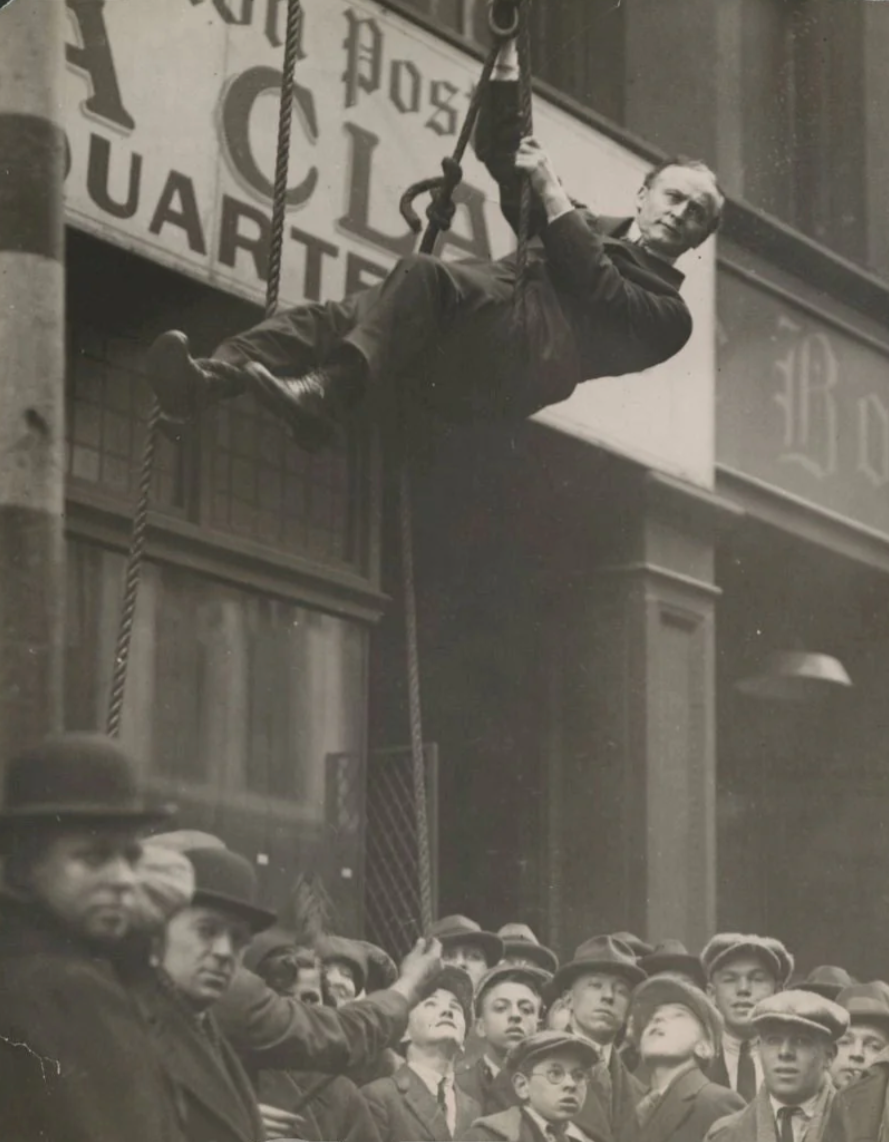
Houdini hangs over a crowd at The Boston Post in Downtown Boston, circa 1900-1920
The City of Magic Some of Us Never Stopped Believing In
How a hidden chapter of Boston’s past may help shape its creative future
Article 4 of 7
The first three articles in this series have been about systems.
About economics. Infrastructure. The structural gap between what Boston’s creative economy has produced and what it has failed to sustain. About the model — immersive, experience-driven, commercially rooted — that can complete the ecosystem.
That argument is made. The case is built.
But there’s a layer to this conversation I’ve been holding back.
Not because it isn’t relevant. Because it’s almost too relevant.
It’s about identity. About a chapter of Boston’s history that most people have never encountered — and that, once you know it, is very difficult to forget.
It’s about three people, one city, and a hidden world that most people have walked past without ever knowing it existed.
And it’s about why that world — against all odds — has been hiding in plain sight ever since.
A Different Kind of History
When people think about Boston’s history, they think about:
• The Revolution
• The Freedom Trail
• Academia
• Politics
• Sports championships
But there’s another history here.
A quieter one.
A stranger one.
And, in many ways, a more theatrical one.
Boston was once a city deeply connected to the world of magic, illusion, and the unexplained.
The Man at 103 Court Street
In 1887, a young musician and self-taught magician named William Davis LeRoy arrived in Boston from San Francisco.
He never left.
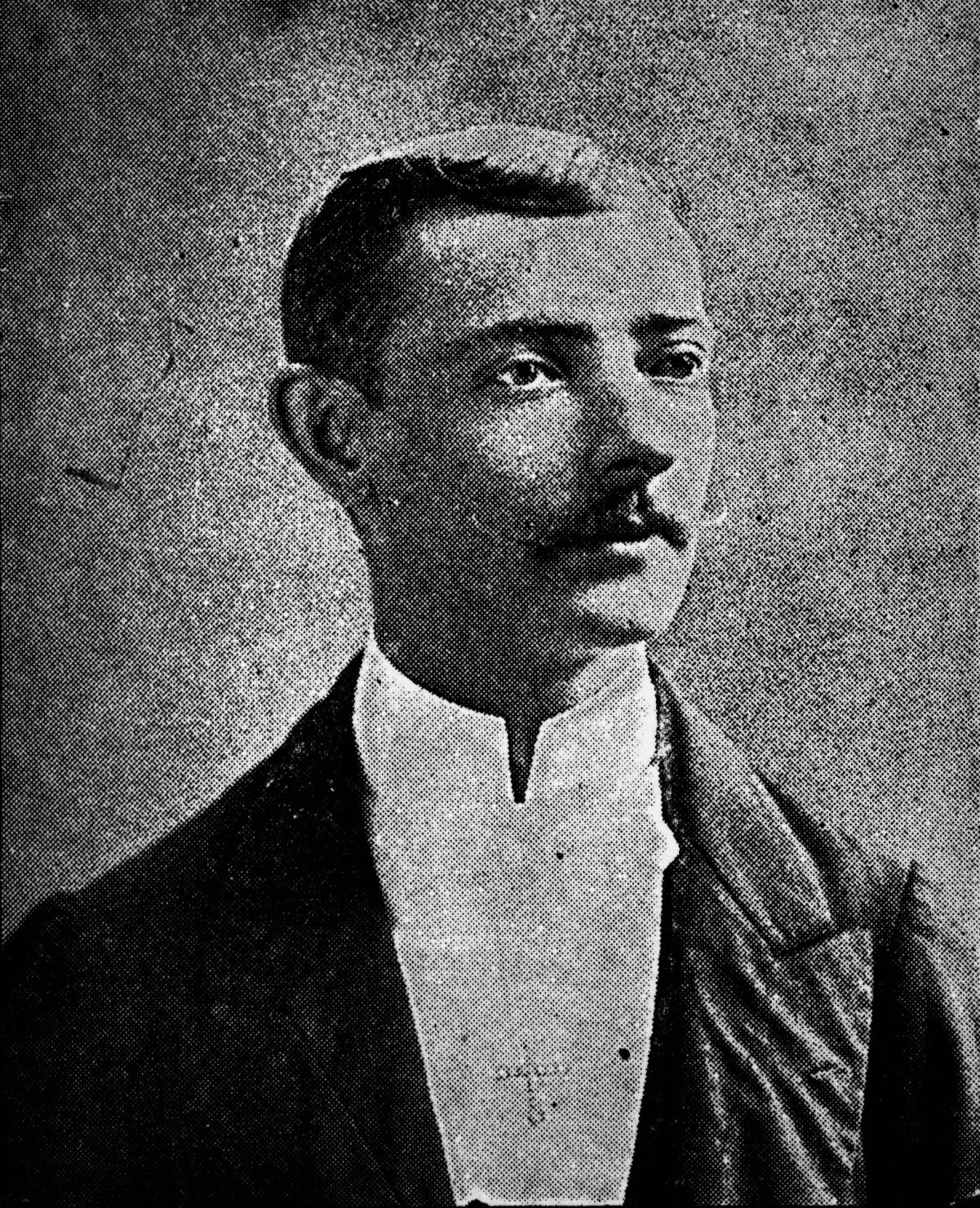
William Davis LeRoy
By the late 1880s, LeRoy had opened the Boston School of Magic on the second floor of the Blanchard Building at 103 Court Street — one of only a handful of such schools in the entire country. For $75, you could learn sleight of hand, escape from a pair of handcuffs, and study the craft from a professional instructor. You could also browse what became the most comprehensive magic catalog in the nation.
That catalog is worth pausing on.
LeRoy’s Mammoth Pictorial Catalogue — covering conjuring wonders, second sight, and what he called ‘anti-spiritualistic illusions’ — reached magicians across the country and around the world. Orders arrived from as far as Australia. Magicians who could never visit Boston could still access LeRoy’s knowledge, his props, his methods. In an era before the internet, before broadcast media, before any centralized infrastructure for the craft, a man on Court Street in Boston was quietly supplying and shaping an entire profession.
He did more than sell magic.
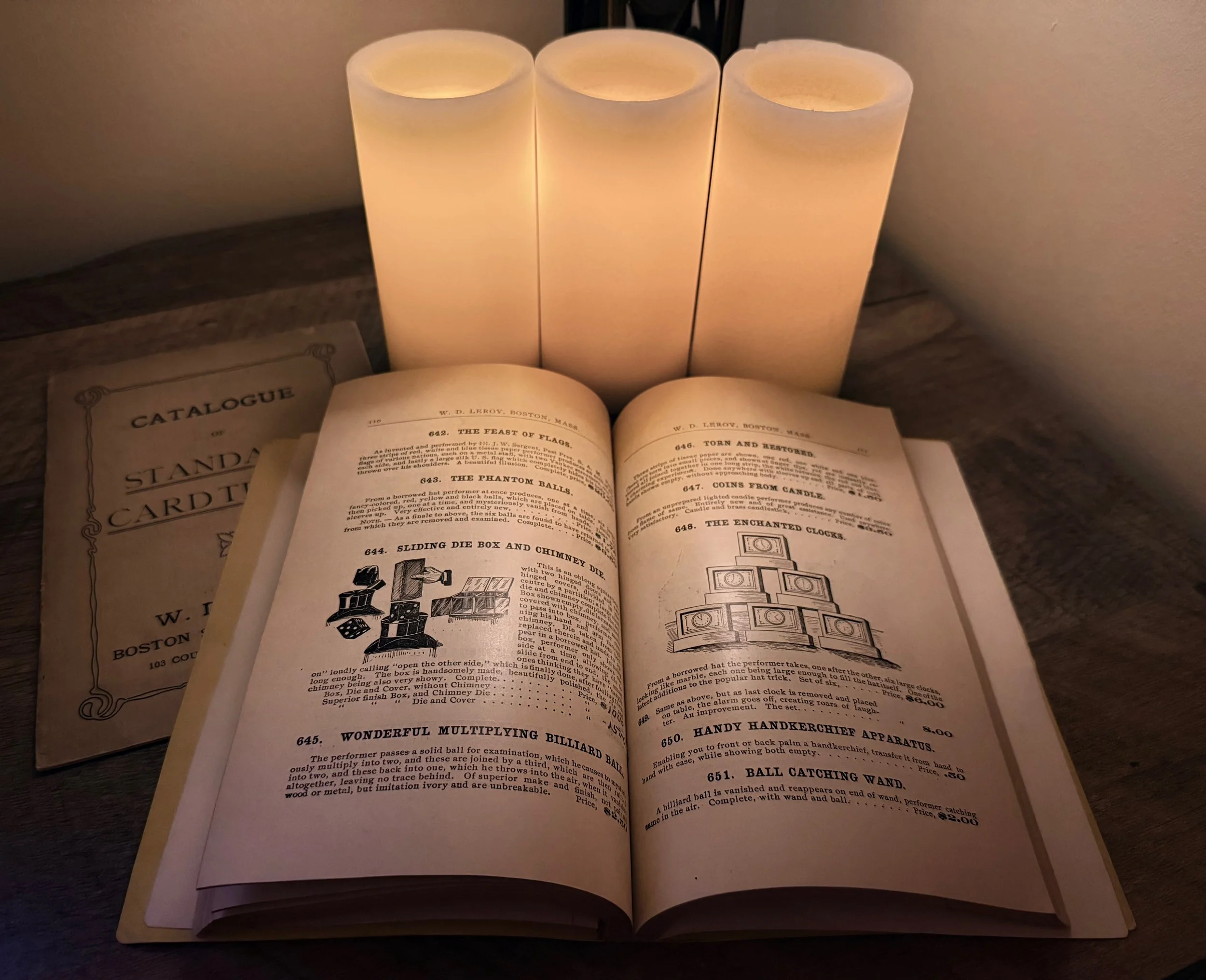
LeRoy’s Mammoth Pictorial Catalogue, circa 1907
When the Society of American Magicians was founded in 1902, LeRoy became member number 33. In the organization’s first fifteen years, he was personally responsible for recruiting one of every six members. He didn’t just participate in building the national infrastructure of magic as a profession.
He was one of its primary architects.
And he founded The Conjurers’ Club of Boston — a fraternal society for amateur and professional magicians that the Boston Globe confirmed was still active in 1917, with LeRoy presiding as its President.
But in less than two years LeRoy would be dead.
The Spanish flu pandemic had devastated Boston as severely as almost any city in America. His death certificate lists Bright’s disease of the kidneys and valvular disease of the heart — both conditions can be secondary complications of severe influenza infection. Whether the pandemic took him directly or through its complications, he was 56 years old and had spent thirty-two years building something in this city that most people have since forgotten entirely.
The Blanchard Building was eventually demolished.
But LeRoy’s story doesn’t end there.
Houdini and Boston: A City of Challenge and Spectacle
Few figures represent this era more than Harry Houdini — and Boston played a meaningful role in his career.
In October 1895, Houdini was performing at the Palace Theatre on Court and Sudbury Streets in downtown Boston — billed in the Boston Globe alongside The American Gaiety Girls, a troupe he had recently begun managing. The Palace Theatre stood steps from 103 Court Street.
LeRoy’s Boston School of Magic was on the second floor of the Blanchard Building at that same address.
Records confirm that Houdini purchased an escape act from LeRoy in September of that same year — and that the two continued corresponding and doing business together for at least the next five years. Letters between them discuss the mechanics of handcuff escapes in precise detail.
By 1899, contemporaries were writing about the two men appearing together socially — described in the trade press as arriving at gatherings of magicians side by side, LeRoy the established Boston authority, Houdini the young phenomenon on the edge of becoming something the world had never quite seen before.
The Palace Theatre and the Blanchard Building shared a wall. There was no alley, no gap, no distance between them. Houdini performed on one side of that wall. LeRoy worked on the other.
Both buildings stood in Scollay Square — the same entertainment district we traced in the first article of this series, the one Boston would raze in 1962 to build Government Center. The Blanchard Building was gone before that demolition, lost to earlier decades. But the Palace Theatre survived until the wrecking ball came.
Today, the approximate footprint where the Boston School of Magic and the Palace Theatre once stood is occupied by the John F. Kennedy Federal Building — home to the Boston offices of U.S. Senators Elizabeth Warren and Ed Markey.
Apparently some things are harder to escape from than a locked trunk.
But in 1895, none of that was gone yet. Scollay Square was alive. And Houdini was only beginning.
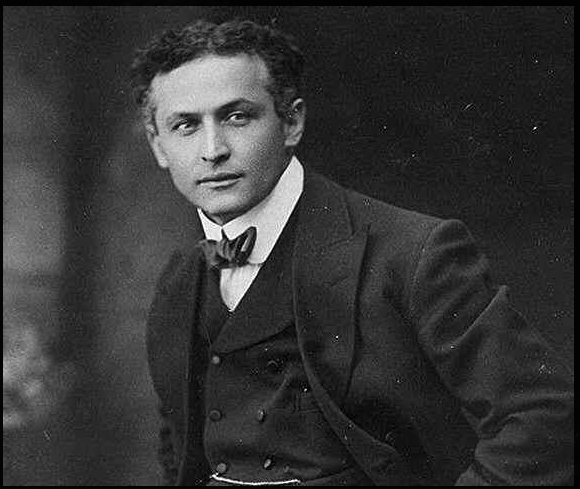
Harry Houdini
Houdini performed in Boston numerous times throughout the early 1900s, often using the city not just as a stop on a tour, but as a stage for something bigger.
He understood something fundamental about audiences here:
Boston didn’t just want to be entertained.
It wanted to be convinced.
So he leaned into that.
He staged public challenges — inviting police departments, journalists, and skeptics to test his abilities.
Jail escapes.
Handcuff challenges.
A leap from the Mass Ave bridge while handcuffed.
Public demonstrations designed not just to amaze, but to provoke debate.
These weren’t passive performances.
They were events — blending spectacle, media, and audience participation.
When it came time to take his act indoors, Houdini was often found at B.F. Keith’s Theatre at 547 Washington Street — the very house built by the Boston impresario whose influence on American commercial entertainment we’ve already traced in this series. Keith’s theatre was Boston’s premier venue for exactly the kind of spectacle Houdini embodied: large scale, commercially savvy, and built to fill seats night after night.
During one legendary Boston engagement, Houdini was challenged by local businessmen to escape from inside a 1,600-pound sea creature pulled from Boston Harbor. He succeeded. He never explained how.
The Medium at Lime Street
If LeRoy was Boston’s quiet architect of magic, and Houdini was its most spectacular performer, then Mina Crandon was something else entirely.
She was its most dangerous question.
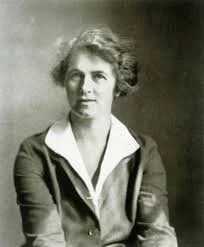
Mina “Margery” Crandon
She performed under a pseudonym — “Margery” — given to her by a Scientific American editor who wanted to protect her social standing as the wife of a prominent Boston surgeon. Her real name was Mina Crandon. And by the early 1920s, under either name, she was the most famous and controversial medium in the world. From her home at 10 Lime Street on Beacon Hill, she held séances that drew international attention. Sir Arthur Conan Doyle attended. W.B. Yeats attended. Harvard University investigators examined her in a windowless room on the third floor of Emerson Hall, where scholars from mathematics, astronomy, biology, and psychology scrutinized what they witnessed.
What made Crandon unlike virtually every other medium of her era was this: she had never accepted payment for a séance in her life. The $2,500 Scientific American prize held no interest for her — the Crandons were wealthy, and the money was never the point. What she wanted was something Houdini could never offer her: legitimacy. Vindication. The acknowledgment from a scientific body that what she experienced was real.
What she built at 10 Lime Street was, in the language we now use, immersive theatre — intimate in scale, environmental in design, utterly dependent on what the audience brought with them into the room. But her audience wasn’t ordinary.
Over a four-year period beginning in 1923, she submitted to nine formal investigations by some of the most rigorous analytical minds in the country — William McDougall, head of Harvard’s Department of Psychology; Daniel Comstock of MIT, the scientist who had just invented Technicolor; physicists, biologists, psychologists, and parapsychologists from institutions on both sides of the Atlantic. The Scientific American investigation alone involved ninety sittings. These were not credulous men. They took exhaustive notes. They designed controlled conditions. They built fraud-prevention devices. And after all of it — they deadlocked. Most couldn’t bring themselves to declare her a fraud publicly, even when they suspected it privately.
Then Houdini arrived.
He attended one séance, climbed into his car afterward, and declared: ‘I’ve got her. All fraud.’ He then built a wooden cabinet — the ‘Margie Box’ — designed to contain her limbs and prevent any physical manipulation of objects in the dark. At the next séance, still confined in the box, the phenomena continued. Then the lid forced itself open from the inside. Houdini reinforced it with additional padlocks. The phenomena continued.
He published a pamphlet. He reproduced her ‘manifestations’ on stage across the country. He was relentless — and it’s worth asking why.
Because if Crandon was real, Houdini had a problem that went far beyond professional pride. His entire career was built on the premise that the impossible has an explanation — that what appears to be magic is always, under sufficient scrutiny, a trick. He had spent decades as America’s most famous skeptic, building an industry around the exposure of mediums. If a woman in a Beacon Hill drawing room could do what she claimed, not only was his livelihood threatened, but the foundational argument of his life was wrong.
And she was a woman. In 1924. Challenging the greatest showman in the world from a position of complete social advantage — wealthy, connected, championed by Sir Arthur Conan Doyle, beloved by the Boston Ivy League establishment, utterly indifferent to the prize money. She didn’t need Houdini’s approval. She wanted his defeat.
The most unsettling detail of all involves a bell. The centerpiece of the Scientific American investigation was a small electrical bell box placed on a table outside the Margie Box — in plain sight of the committee, physically out of reach of anyone sealed inside. The entire premise was simple: if Crandon could cause that bell to ring while locked in the cabinet, with no possible physical contact, she would have demonstrated genuine psychic phenomena under controlled scientific conditions. A folding ruler was discovered inside the cabinet — an object precisely long enough to extend through one of the openings and reach the bell on the table outside, allowing her to trigger it manually without breaking free. Crandon accused Houdini of planting it to discredit her. Houdini denied it. Years later, his assistant Collins reportedly admitted: ‘I chucked it in the box meself. The Boss told me to do it.’
The man who built his life on exposing fraud may have committed it.
Crandon never admitted to trickery. Not during the investigations. Not after Houdini’s exposure. Not in the years that followed, as spiritualism faded and the world moved on. She held her position until her death in 1941.
Which leaves the question exactly where both of them left it:
What is real — and what do we choose to believe?
The Experience Behind the Illusion
That question is where magic and theatre intersect.
Because at its core, magic — like theatre — isn’t just about trickery.
It’s about experience.
It’s about creating a moment where the audience leans in, suspends disbelief, and feels something they can’t fully explain.
Houdini understood that.
And Boston, with its mix of curiosity and skepticism, was the perfect place to test it.
The Lost Layer of Boston’s Entertainment Identity
Over time, much of this history faded.
The venues changed.
The industry evolved.
The city modernized.
And the more unusual, immersive, and experiential forms of entertainment began to disappear — or move elsewhere.
What remained was a more conventional version of theatre.
Important.
Valuable.
But only one piece of what once existed.
Why This Matters Now
In the last article, I made the case that immersive, experience-driven entertainment isn’t a creative trend — it’s a direct response to where audiences have already moved.
What’s interesting is that this isn’t entirely new.
In many ways, it’s a return.
LeRoy’s Conjurers’ Club wasn’t a passive gathering. It was an environment — a world constructed for discovery, for mystery, for the kind of experience that required your active participation to work. Houdini’s Boston performances weren’t theatre in the conventional sense. They were events — public challenges, staged confrontations, experiences that blended spectacle with skepticism and dared the audience to engage. And Crandon’s séances were the most immersive theatrical experiences Boston had seen in decades — intimate, environmental, participatory, and utterly dependent on what the audience brought with them into the room.
These weren’t precursors to immersive entertainment.
They were the original version of it.
The difference is that now — with the tools, the talent, and the audience demand we’ve built toward across this series — there is an opportunity to build it again. Not as nostalgia. Not as revival. But as something that takes this city’s most extraordinary hidden history and makes it fully, physically alive.
Reconnecting Past and Future
If we think about Boston’s future in commercial theatre, we often focus on what needs to be built.
But there’s another way to look at it.
Not just building something new —
But reconnecting to something that was already here.
A form of entertainment that blended performance and environment, invited audiences into the experience rather than seating them in front of it, and created a sense of mystery and participation that no conventional stage could replicate.
That’s not a new idea.
It’s a rediscovered one.

William Davis LeRoy’s Boston School of Magic
What Comes Next
So far in this series, we’ve talked about:
The gap in Boston’s commercial theatre ecosystem
The structural challenges of building within it
The emergence of immersive, experience-driven entertainment
And the history that connects all of it
The next step is to bring those ideas together.
Because when you combine:
A city with this kind of history
A workforce with this level of talent
And an audience actively seeking new kinds of experiences
You start to see something take shape.
Not just an idea.
But something much more tangible.
LeRoy. Houdini. Crandon. Three figures who spent their lives asking the same question in different ways.
What is real — and what do we choose to believe?
That question never got a final answer. And something about this city — its history, its architecture, its particular appetite for both skepticism and wonder — has kept it alive.
The next article in this series begins to answer it.
Boston has always been a city of stories.
Some of them we tell openly.
And some of them…
We’re only now beginning to rediscover.
— Jonathan