
Article Series: The Future of Theatre in Boston
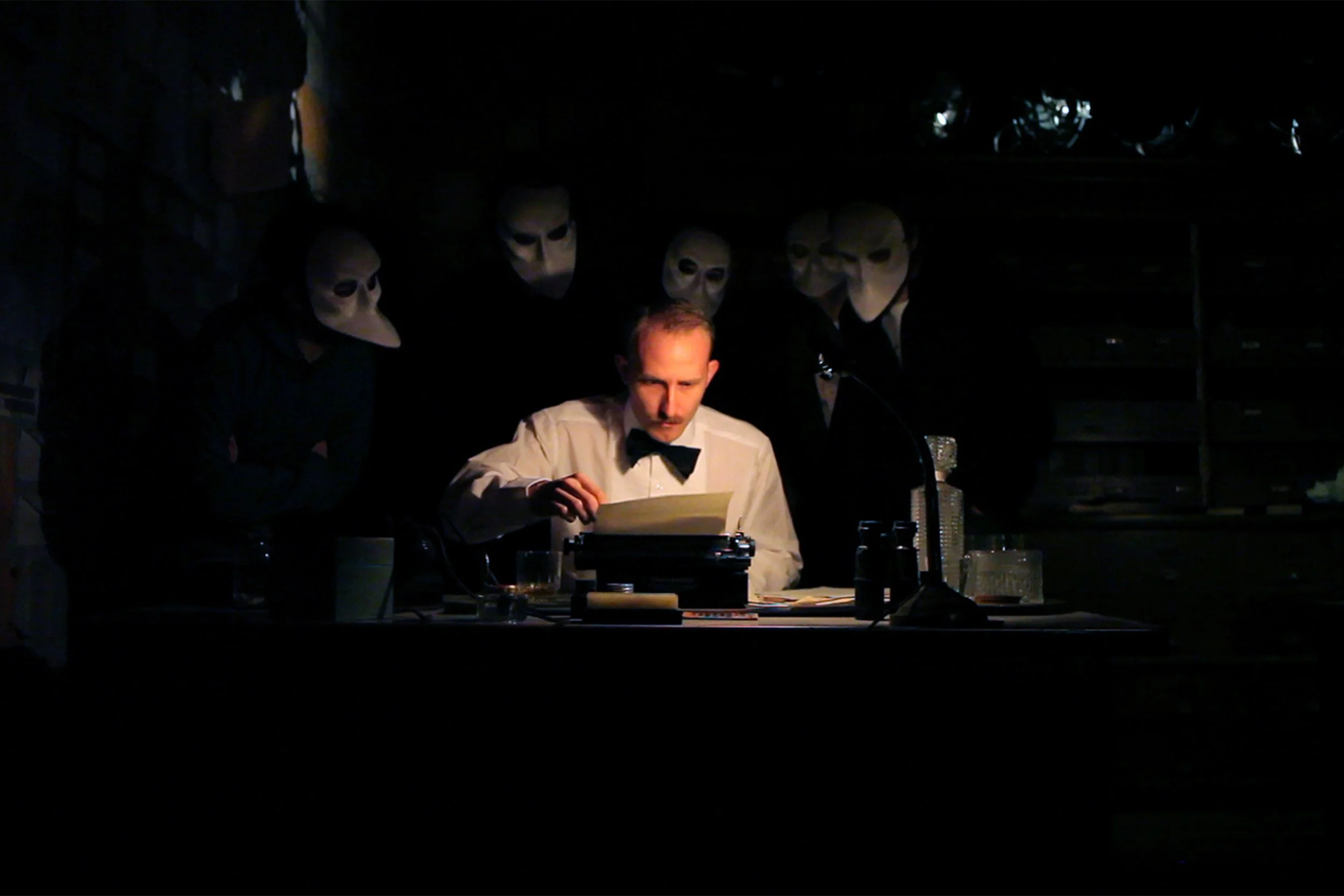
Sleep No More at the McKittrick Hotel, New York City
The Future of Theatre Isn’t Just On Stage -
It’s All Around You
Why experience-driven entertainment is reshaping the industry—
and where Boston fits in
Article 3 of 7
In this series we’ve been building a case in layers.
Article 1 identified the structural gap — why cities with extraordinary creative talent still struggle to sustain the people who create. Article 2 established the proof of concept — that Boston has already demonstrated, multiple times, that commercial theatre can work here at scale.
Now the third leg of our tripod metaphor.
Because the model that can complete this ecosystem isn’t theoretical. It’s already being built — in New York, in London, in cities that recognized early what audiences were beginning to demand.
And it’s changing how people engage with live performance in a fundamental way.
From Watching to Experiencing
For most of its history, theatre has been built around a simple idea:
An audience sits.
A performance happens.
The experience ends.
But that model is evolving.
Today’s audiences are looking for something more:
Interaction
Immersion
Personal connection
A sense of discovery
They don’t just want to watch a story.
They want to step inside it.
The Rise of the Experience Economy
This shift isn't unique to theatre—it's happening across industries.
People are prioritizing:
Experiences over products
Memory over ownership
Social engagement over passive consumption
The data bears this out — and it's only grown stronger since the pandemic.
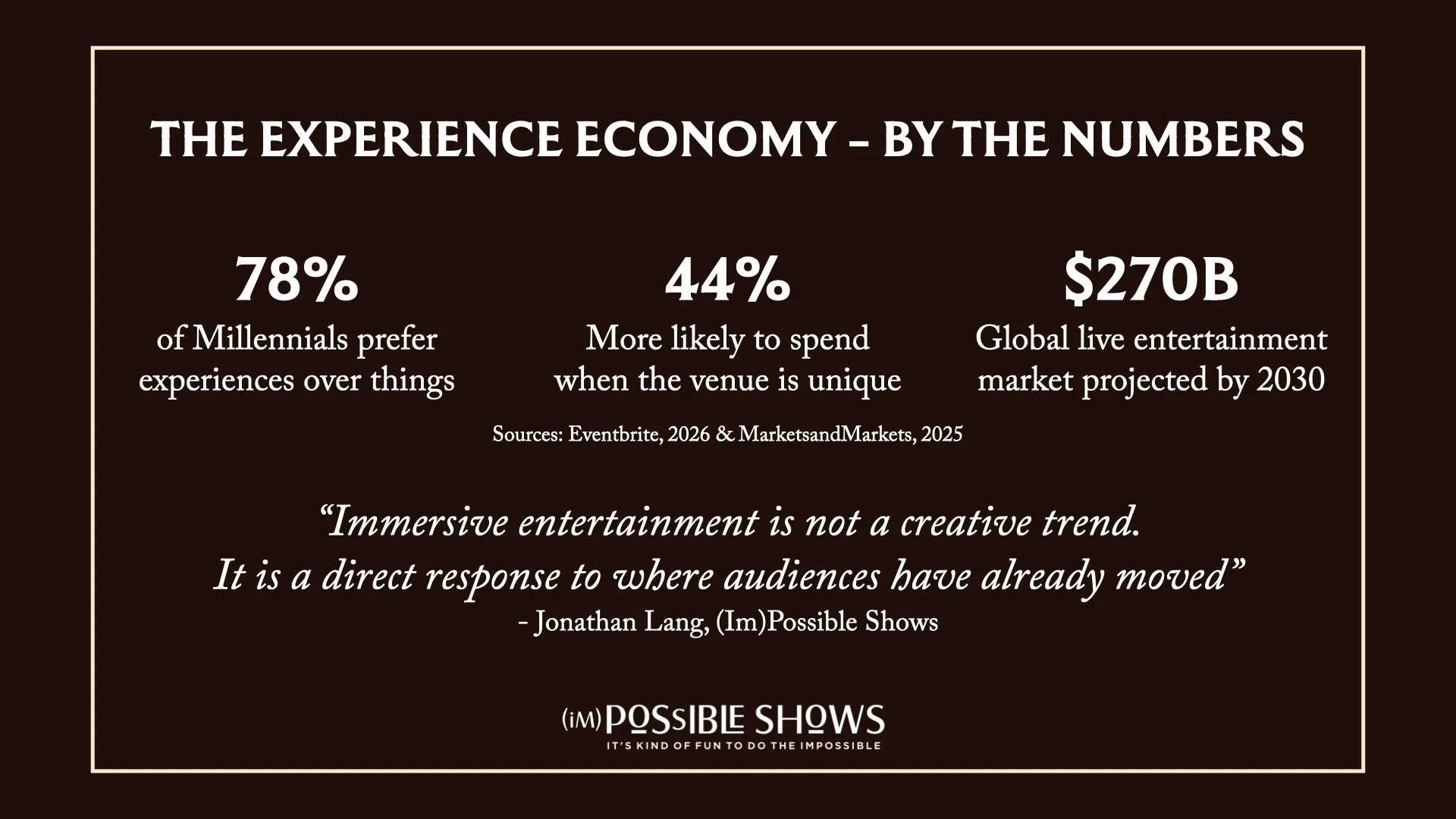
Eventbrite has found that 78% of Millennials would rather spend money on an experience than on a material thing. And its 2026 "Reset to Real" study shows the trend accelerating in exactly the direction immersive work is built for: 79% of 18-to-35-year-olds plan to attend more live events, and what they increasingly crave are gatherings that feel less choreographed and more real — "unrepeatable moments that could only happen once." They are trading passive attendance for active participation, and predictable venues for surprising ones.
This isn't a generational quirk. It's a structural shift in how people assign value.
The global live entertainment market reflects it directly — projected to grow from $202 billion in 2025 to $270 billion by 2030, driven specifically by rising consumer demand for immersive, real-time experiences.
For theatre producers, the implication is clear: immersive entertainment is not a creative trend.
It is a direct response to where audiences have already moved.
And the models that meet audiences there are the ones that will sustain themselves commercially.
What Immersive Theatre Changes
Immersive theatre doesn't replace traditional theatre.
It expands what theatre can be.
Instead of:
A single stage
A fixed audience perspective
A defined beginning and end
You get:
Multiple environments
Layered storytelling
Audience choice and movement
A nonlinear experience
In many cases, the performance isn't something you sit and watch.
It's something you navigate.
That sense of navigation introduces something else that's incredibly powerful:
Uncertainty.
You don't know exactly what you're going to see.
You don't know what path you'll take.
You don't even know if the experience you have will be the same as the person next to you.
In that way, immersive theatre begins to tap into something we already know audiences respond to—what makes live sports so compelling.
Every game is different.
Every outcome is unknown.
And the experience only exists in that moment.
Immersive theatre brings a version of that same dynamic into storytelling.
It creates a sense that what you're experiencing is live, personal, and unrepeatable.
And that has real implications—not just creatively, but commercially.
Because when audiences feel like something is unique to them—and can't be replicated exactly—it increases both desirability and the likelihood that they'll return.
Why Nontraditional Space Is an Advantage
One of the biggest advantages of immersive theatre is that it does not have to rely on a traditional theatre building.
That matters in Boston.
Traditional theatrical space is limited, expensive, and often already spoken for. If every new commercial production needs a proscenium stage, fly system, dressing rooms, lobby, backstage support, and a conventional seating configuration, the number of viable locations becomes very small very quickly.
Immersive theatre changes that equation.
More often than not, immersive work becomes more compelling when it is housed in a nontraditional space:
A former retail location
A historic building
A warehouse
A hotel ballroom
A hidden storefront
A repurposed commercial space
The building becomes part of the story.
Instead of forcing theatre into a conventional box, immersive entertainment allows producers to activate spaces that might otherwise sit empty or underused.
That is especially important in a city thinking seriously about downtown revitalization, small business development, and the future of commercial real estate.
A Current Proof Point: Masquerade in New York
We are seeing this play out right now in New York.
Masquerade — directed by Tony Award winner Diane Paulus and produced by Randy Weiner — is an immersive reimagining of Andrew Lloyd Webber's The Phantom of the Opera, currently running at 218 West 57th Street in a transformed multi-floor commercial building. From rooftop terraces to subterranean chambers, audiences move through a fully realized version of the Paris Opera House, with scenes unfolding inches away from them, characters emerging from shadows, and the building itself becoming part of the story.
There is no traditional theatre seat. No fixed stage. No passive audience.
What makes Masquerade particularly instructive as a business model is its architecture of repetition. Six separate audience groups move through the show each night, staggered by fifteen minutes, each experiencing a different pair of performers as the Phantom and Christine. The result is a show that is simultaneously running six times — and one that audiences are compelled to return to, because no two visits are identical. Demand has been strong enough that the production has extended repeatedly, and is now booked into 2027.
The industry has embraced it as much as audiences have: Diane Paulus won the 2026 Outer Critics Circle Award for Outstanding Direction of a Musical, and Masquerade won a 2026 Drama Desk Award for Outstanding Creative Collaboration.
But here's the detail that connects directly to Boston: Randy Weiner — Masquerade's producer — also produced Sleep No More, the landmark immersive production that had its early development at A.R.T. here in Boston before becoming one of the most celebrated immersive experiences in the world.
That is not a coincidence. That is a producer who has built an entire commercial career around the immersive model — proving that this isn't a niche experiment.
It's a sustainable business.
That connection runs deeper than most people realize. Weiner's wife, Diane Paulus — currently the Artistic Director of the American Repertory Theater at Harvard — co-created The Donkey Show with Weiner in 1999 and brought it to Boston's A.R.T. at the start of her tenure there. It was Weiner who first connected the A.R.T. with Punchdrunk — the British theatre company whose work would go on to define the immersive form globally. And now, twenty-five years later, the same creative partnership has produced Masquerade — currently one of the most acclaimed immersive theatrical productions in America, and a 2026 Drama Desk Award winner.
Three productions. One creative partnership. A career built on the immersive model.
And Boston was in the room for two of them.
The proof of concept isn't coming. It's already here.
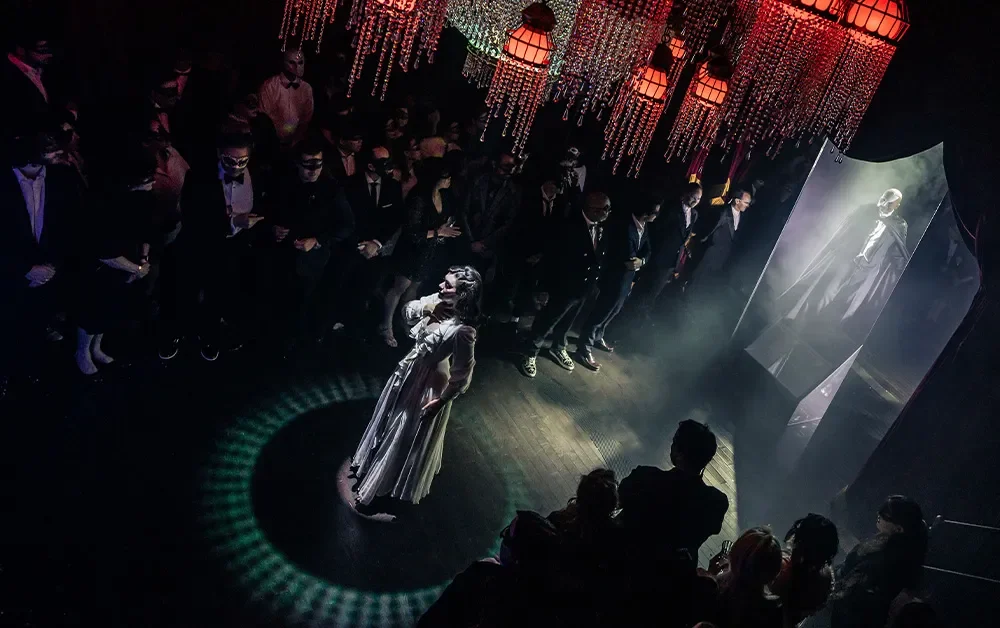
The audience watches as the Phantom seduces Christine in MASQUERADE
Photo: Matthew Murphy & Evan Zimmerman
Why This Model Works
From a creative standpoint, immersive theatre unlocks new storytelling possibilities.
But from a business standpoint, it does something equally important:
It changes the economics.
Experiences like this can:
Encourage repeat attendance
Extend length of stay
Create multiple points of engagement within a single visit
Build stronger word-of-mouth through shareable moments
Allow food, beverage, merchandise, and private-event revenue to become part of the operating model
And importantly:
They create a sense of exclusivity.
Not everyone has the same experience.
Not everyone sees the same thing.
Which makes people want to come back.
A Natural Fit for Boston
Boston is uniquely positioned for this kind of work.
Not just because of its audience — but because of its physical and cultural DNA.
This is a city of hidden doors and layered architecture. Narrow streets that lead somewhere unexpected. Buildings with centuries of stories embedded in their walls. A place where something can exist in plain sight and still feel undiscovered.
That is precisely the terrain immersive storytelling is built for.
And there’s a dimension to Boston’s history — one most people have forgotten — that makes it an even more natural home for this kind of work than most people realize.
We’ll get to that in the next article.
But the foundation is already here. The question is whether we’re ready to build on it.

Boston is a city of hidden doors and narrow streets that lead somewhere unexpected
We’ve Already Seen Glimpses of It
The through-line across all of these productions — The Donkey Show, Sleep No More, and now Masquerade — is that Boston has not just witnessed the development of immersive theatre. It has actively shaped it.
Projects like Sleep No More had early life here before evolving into one of the most recognized immersive productions in the world.
Experiences like The Donkey Show demonstrated that Boston audiences are willing — and eager — to engage with theatre in more social, participatory environments.
The foundation is there.
And the appetite extends beyond those landmark productions.
In the winter of 2022, I served as the local general manager for a touring immersive theatrical experience in Boston that sold out every performance for 13 consecutive weeks — months before the production even opened its doors.
The demand was unambiguous. Audiences were lining up, paying in advance, and showing up.
But here’s what that experience also taught me: demand alone isn’t enough. Boston audiences don’t just want immersive entertainment. They want immersive entertainment that respects them — that meets the high standard this city has always held for the work it embraces.
The market is here. The question is what we build to serve it.
What’s been missing is scale—and continuity.

Where This Connects to the Bigger Picture
When we talk about building a commercial theatre ecosystem in Boston, this is where the conversation starts to become actionable.
Because immersive, experience-driven theatre:
Aligns with current audience behavior
Creates stronger revenue models
Supports long-term employment
Reduces dependence on traditional theatre real estate
Activates underused commercial space
And integrates naturally into the city’s broader entertainment landscape
It’s not just an artistic evolution.
It’s a business evolution.
What Comes Next
If Article 2 was about understanding the system we’re missing, this is about recognizing the model that can help build it.
Because the next question isn’t:
“Can Boston support commercial theatre?”
We already know it can.
The question is:
What kind of theatre should we be building now?
And how do we build it in a way that:
Creates jobs
Supports small business growth
Keeps talent here
Uses space creatively
And contributes to the long-term cultural and economic future of the city
That’s where we’re headed next.
The opportunity — in Boston and in any city ready to look at this seriously — isn’t just to bring theatre back.
It’s to build something that meets audiences where they already are. Something that feels of this moment. And something built to last.
— Jonathan